Analyzing our annual PV module test results, 13 module manufacturers met RETC’s rigorous standard for our top accolade—namely, recognition as an “Overall Highest Achiever.”
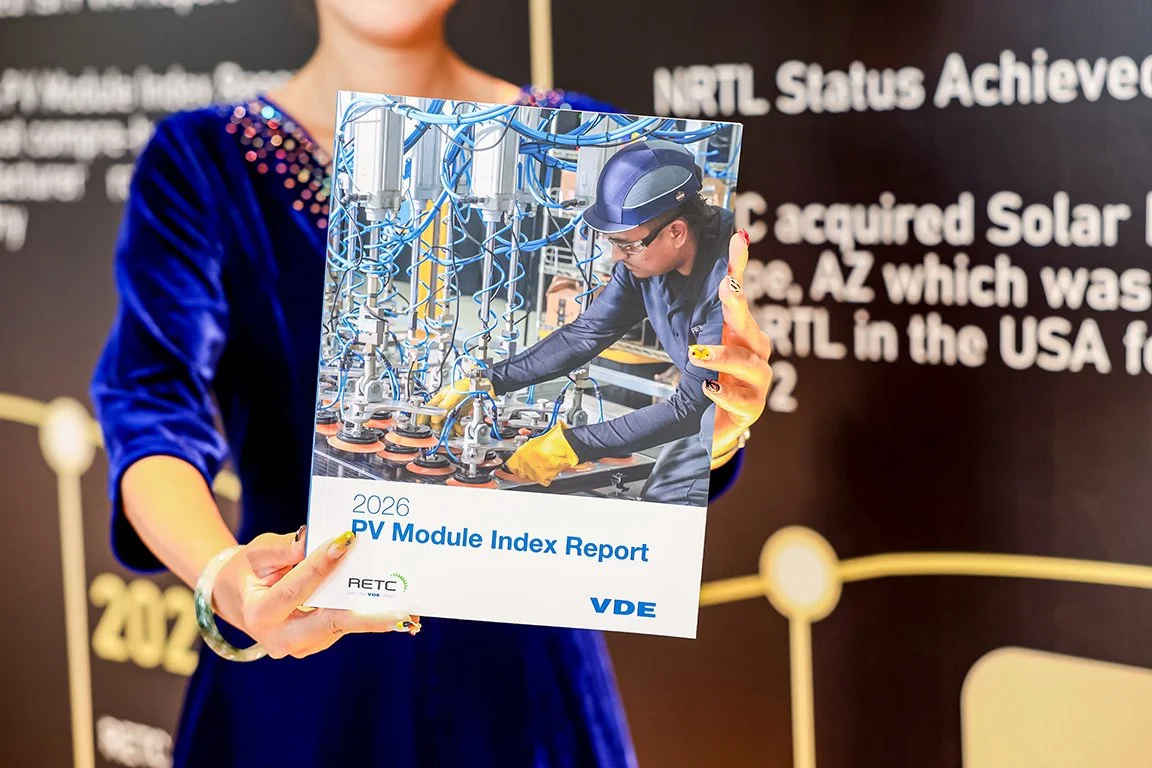
Overall highest achievers
In this preliminary June 2026 release of the PV Module Index Report, RETC recognizes 19 module manufacturers for some form of high achievement across the 14 testing sequences that comprise the reliability and performance disciplines. As in prior years, RETC will publish a final edition ahead of RE+ 2026 incorporating the results of any remaining long-duration test sequences.
To identify the industry’s top-performing PV module products and manufacturers, RETC first evaluated result distributions within each individual test sequence. We then established thresholds for high achievement and red-flag outcomes based on engineering judgment, historical testing experience, and a review of relevant scientific literature. Using these sequence-level benchmarks, RETC conducted a holistic analysis of cross-disciplinary results and applied transparent criteria for recognition, as detailed in this report.
Following this comprehensive review process, RETC identified 13 manufacturers that satisfied the rigorous requirements for “Overall Highest Achiever” recognition.
To earn RETC’s highest distinction, module manufacturers were required to demonstrate excellence across three equally important disciplines: reliability, performance, and quality. In practical terms, “Overall Highest Achiever” recognition signifies that RETC also recognizes these companies for “High Achievement in Reliability,” “High Achievement in Performance,” and “High Achievement in Quality.” This is an exceptionally high bar to pass. RETC commends these module companies for consistently achieving excellence in module manufacturing
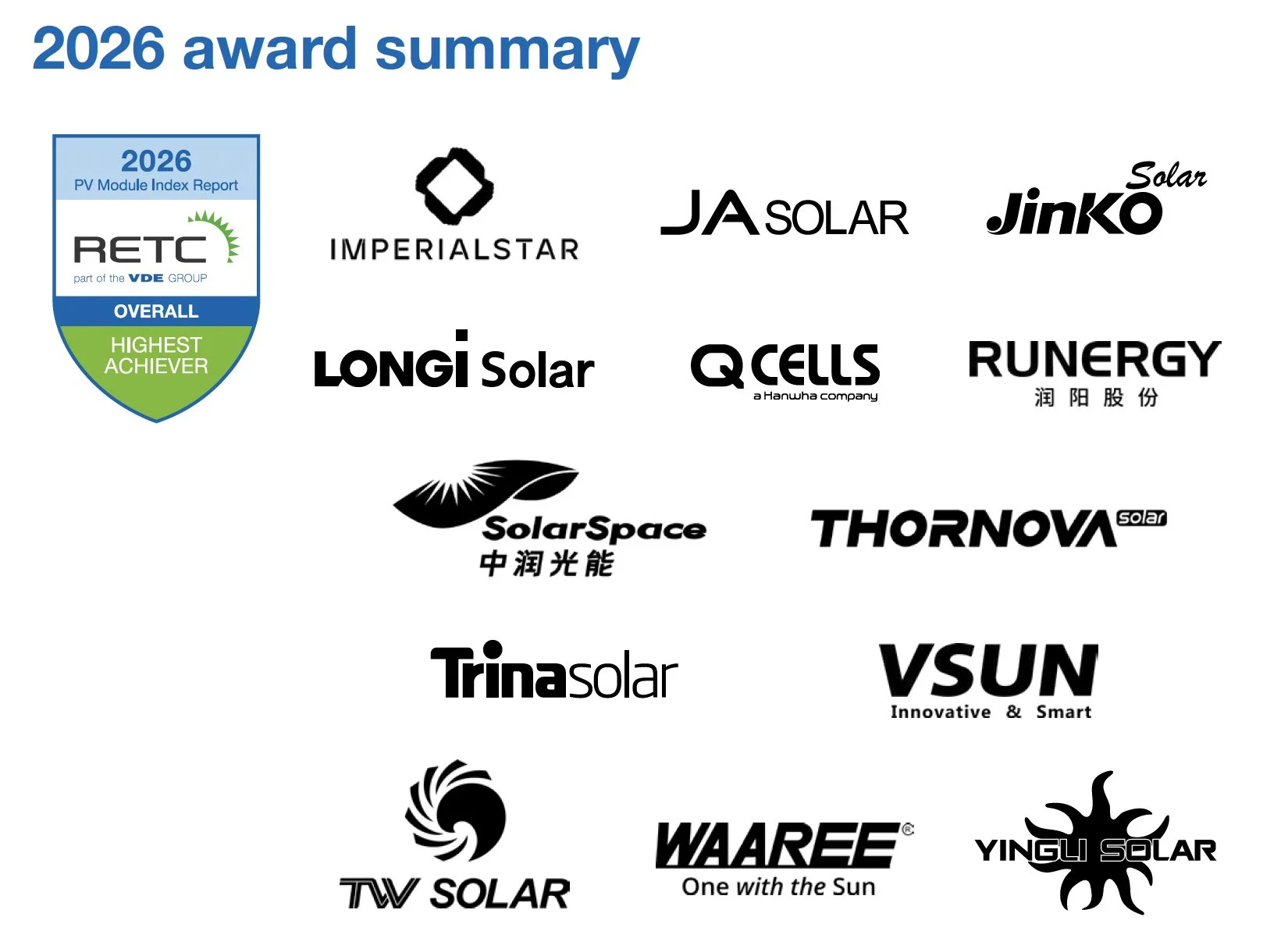
2026 PV Module Index Report “Overall Highest Achiever” awardees
Caveat emptor
Laboratory-observed reliability and performance indicators declined year over year in several key testing categories. With this trend in mind, RETC reminds downstream stakeholders that effective procurement due diligence extends well beyond entering into a supply agreement with a manufacturer recognized for high achievement. Even top-performing manufacturers occasionally produce PV module bills of material (BOMs) that underperform in specific Thresher Test sequences. Stakeholders seeking to procure high-quality products—and avoid elevated technical risk—should request and review the applicable RETC Thresher Test reports for the specific BOMs under consideration.
One recent field investigation illustrates how seemingly minor supply chain changes can materially impact long-term project reliability. In this particular case, a developer constructed a solar project in two phases using PV modules from what the manufacturer represented as the same BOM. The developer installed roughly half of the procured modules in Phase 1 and the remainder in Phase 2. After commissioning, however, the two project phases exhibited dramatically different field durability. Specifically, one project phase experienced a 1% glass breakage rate, while the other saw a breakage rate approaching 15%.
To identify the root cause, the developer submitted spare modules from both project phases to RETC for comparative evaluation. RETC conducted certification-level qualification testing rather than enhanced bankability sequences. Modules sourced from the low-failure project phase passed this testing without incident. By contrast, samples from the underperforming phase exhibited failure rates approaching 75% during testing. Visual inspection revealed subtle but meaningful differences in the glass itself, including variations in edge finishing and treatment. Further investigation ultimately confirmed that the manufacturer had sourced glass from two different suppliers without disclosing the change to the project owner. While the manufacturer considered the modules equivalent because they nominally shared the same BOM designation, the supplier substitution materially altered product reliability and field performance.
Cases such as this highlight a growing challenge facing the solar industry as manufacturing landscapes and supply chains evolve under intense pricing pressure, trade restrictions, localization policies, and accelerated factory expansion cycles. In recent rounds of RETC bankability testing, the laboratory has observed a resurgence of PV cell-related reliability issues—including humidity sensitivity, thermal cycling degradation, potential-induced degradation, and metastability effects—that had become relatively uncommon over the past decade. RETC and its field forensics partners are also seeing evidence of structural vulnerabilities, including glass breakage and frame-related failures.
Collectively, these trends reinforce an important reality for project stakeholders: product certification alone is not sufficient to predict long-term reliability and performance. As technologies, materials, and manufacturing practices evolve, independent testing, BOM verification, and ongoing batch testing are essential for validating that delivered products consistently meet reliability and performance expectations over time. Bankability is not a check-the-box compliance exercise. In a terawatt-scale solar market, trust is earned through rigorous technical due diligence followed by proven results over decades of field exposure.
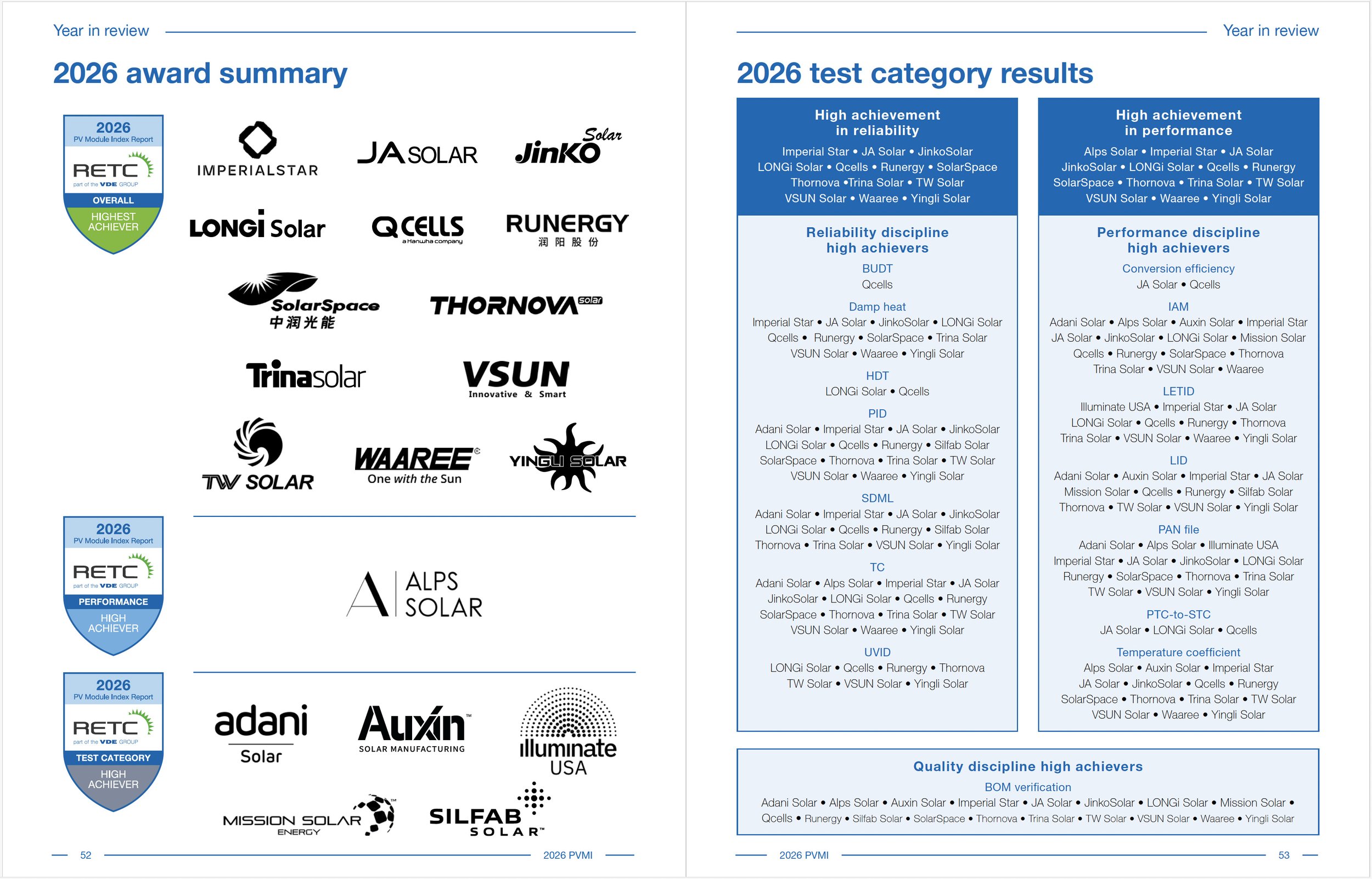
2026 award summary and test category results
Criteria for recognition
Manufacturers must successfully complete RETC’s rigorous Thresher Test program and excel across multiple tests within the reliability and performance disciplines to be recognized as an “Overall Highest Achiever” in the PV Module Index Report. Moreover, module companies must demonstrate a commitment to transparency and quality by allowing an independent third party to randomly select Thresher Test samples.
In the next step down from our top honor, RETC recognizes manufacturers of PV module bills of materials that excel across multiple testing sequences within one specific discipline for “High Achievement in Reliability” or “High Achievement in Performance.” Meanwhile, we recognize manufacturers as “Test Category High Achievers” based on exceptional test sample performance in one or more individual bankability testing sequences.
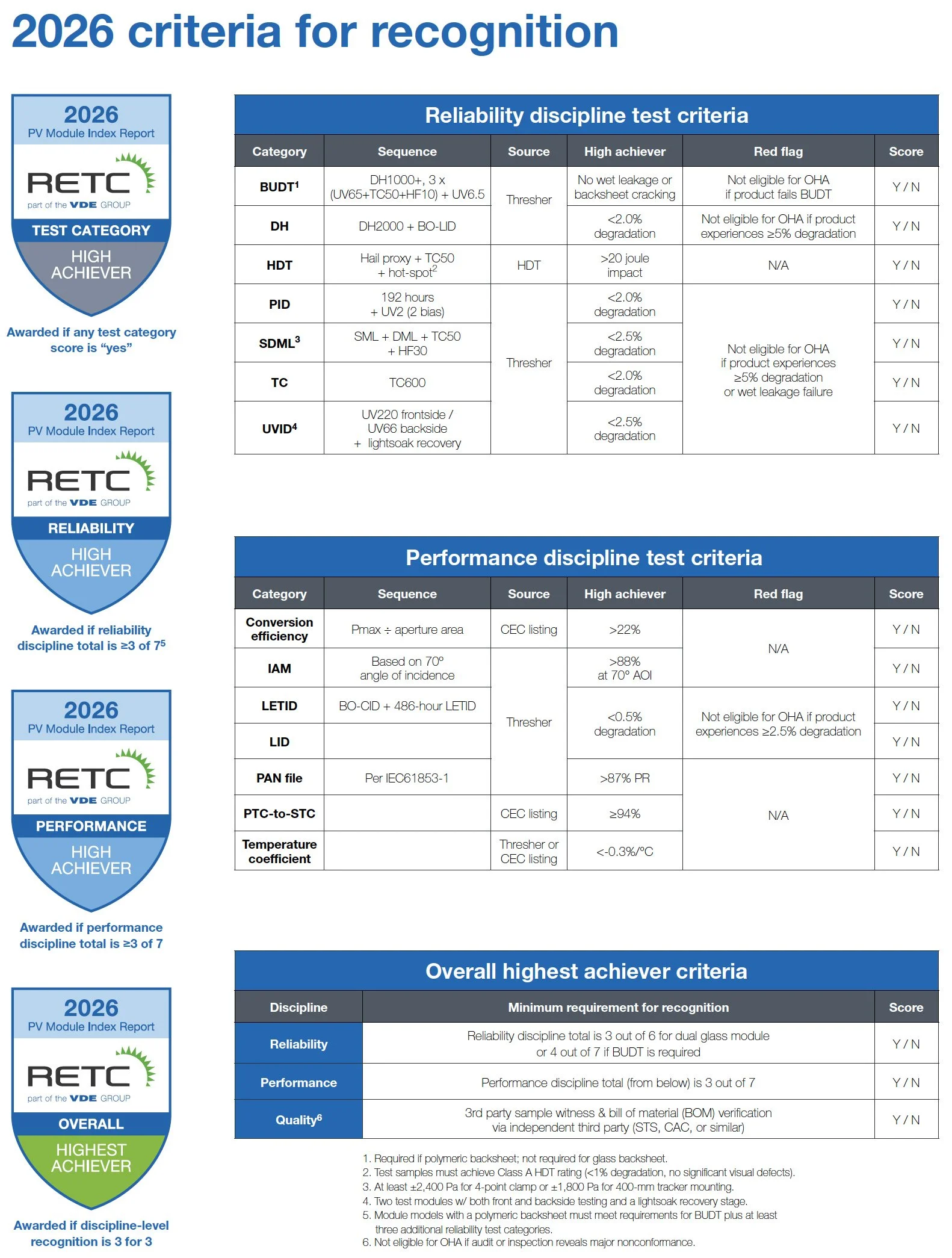
Test category high achievement thresholds and 2026 PVMI awards criteria
About RETC, part of the VDE Group
RETC is an independent testing and certification laboratory specializing in solar and energy storage products. Since 2009, renewable energy manufacturers, developers, financiers, and independent engineers have relied on RETC to generate trusted, third-party data for evaluating product performance, reliability, and bankability. Headquartered in Fremont, Calif., with facilities in Tempe, Ariz., RETC is part of the VDE Group and supports global testing and certification efforts across the energy transition and an expanding range of market segments.
By providing independent, defensible data for photovoltaic (PV) modules, inverters, battery energy storage components, and racking products, RETC helps reduce friction across operational functions. From technical diligence and stakeholder alignment to accelerated market adoption of proven technologies, RETC results and reports inform stakeholders on what products are suitable for large-scale renewable energy deployment. Specifically, the company’s Thresher Test Program is widely utilized to assess the long-term durability of solar panel technologies and to inform procurement, financing, and insurance decisions.
About the PV Module Index Report
As part of the VDE Group, one of the largest technology organizations in Europe, RETC is committed to the advancement of reliable renewable energy technologies. With this goal in mind, RETC’s eighth annual PV Module Index Report compiles the results of beyond-certification bankability tests conducted at our highly accredited independent testing laboratories over 12 months, spanning Q2 2025 through Q1 2026.
The bankability tests published in the disciplines section of this annual report are foundational to a science- and engineering-based approach to technical risk mitigation. The goal of a data-driven approach to project development is not to eliminate every risk at any cost, but rather to balance risk mitigation through a holistic cost-benefit analysis. With this in mind, industry stakeholders can use the comparative test results in this report to identify product or project designs best suited to a specific environment, location, or portfolio, as determined by RETC’s Thresher Test.

Knowledge is power.
Download the 2026 PVMI today!