As solar transitions to a mainstream power source, industry stakeholders must fundamentally change how PV technologies are evaluated for large-scale deployments.

As RETC, part of the VDE Group, publishes its eighth annual PV Module Index Report, global energy markets are reeling due to oil and gas market volatility coupled with electricity demand growth driven by electrification trends and data center development. These twin disruptions highlight the strategic value of solar photovoltaic (PV) investments.
Speed-to-power has never been more important than it is today. As the world wrestles with extended lead times for natural gas turbines, hyperscale computing companies are jockeying for position in the AI race. Solar is uniquely positioned to meet this rising demand for power generation capacity. In addition to being quicker to deploy, utility-scale solar offers a lower levelized cost of energy than natural gas or nuclear power. Moreover, solar at any scale provides a natural hedge against weather- or conflict-related volatility in natural gas prices.
As solar transitions to a mainstream power source, industry stakeholders must fundamentally change how PV technologies are evaluated for large-scale deployments. Granted, product certification largely served the industry well in its infancy. However, the technical due diligence community knows all too well that legally mandated minimum testing requirements are inadequate to support a mature terawatt-scale solar market.
To meet the moment, large-scale solar deployments need to account for the low-probability, high-impact tail risk events—such as one-in-500-year hailstorms—that can cripple an investment portfolio. Site-specific engineering needs to account for real-world conditions of use, which are often more variable and harsher than those in certification testing environments.
Perhaps most importantly, project stakeholders need to approach risk mitigation and performance optimization from a system-level perspective. While component-level certification can meet minimum compliance requirements, enhanced system-level bankability testing ensures that fielded solar assets meet pro forma performance expectations. In this context, bankability is not so much a destination as a process.
After the conclusion of basic type approval and safety testing, RETC’s Thresher Test, the solar industry’s first-ever beyond-certification testing program, differentiates preproduction PV module designs based on expected long-term performance and durability. Once stakeholders have executed high-volume procurement agreements for a resilient bill of materials, periodic production lot testing ensures that the PAN files used for capacity testing are as accurate as possible and that unforeseen material substitutions do not degrade resilience.
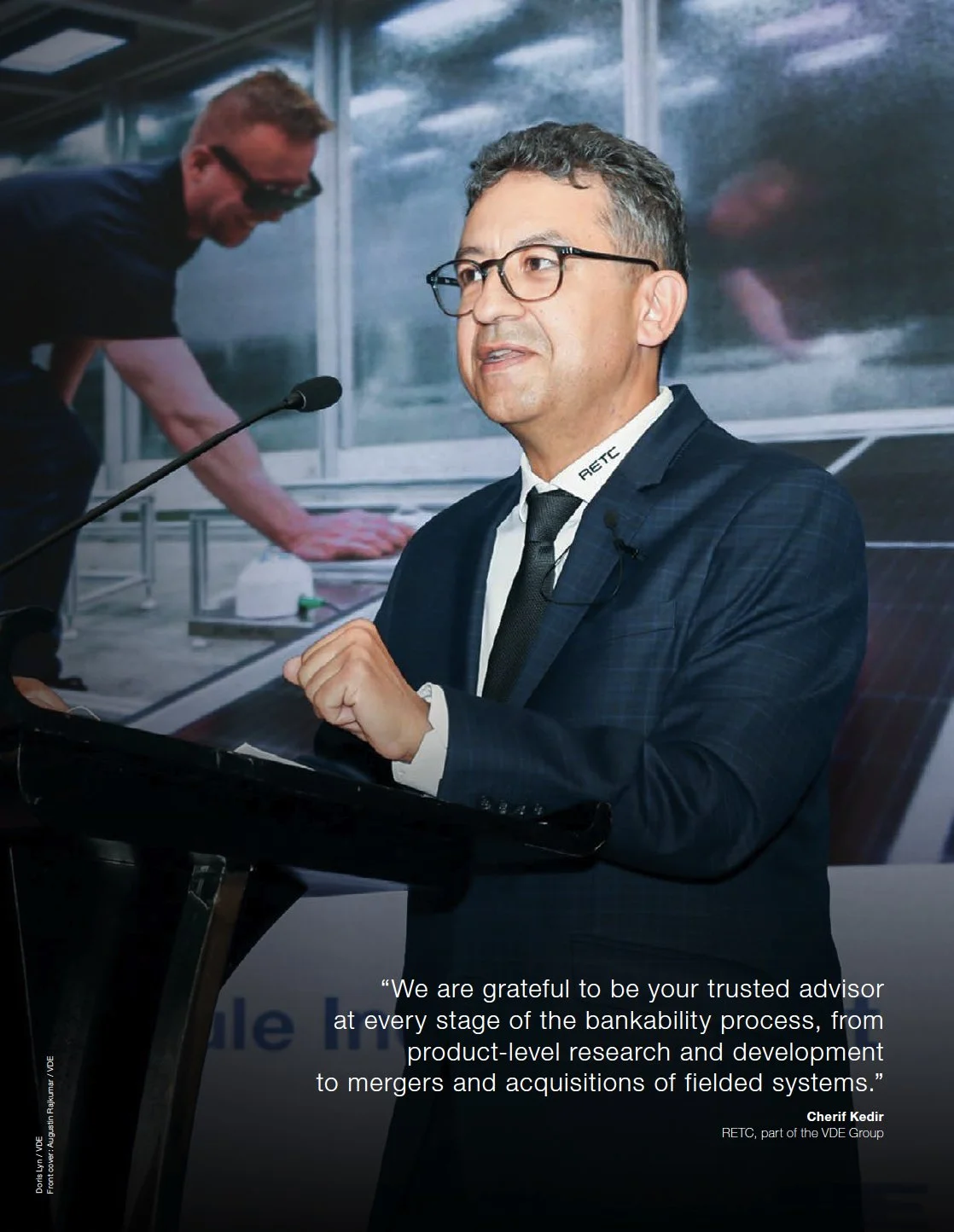
At RETC, we are grateful to be your trusted advisor at every stage of the bankability process, from product-level research and development to mergers and acquisitions of fielded systems. Together, we will rise to meet the moment.
—Cherif Kedir, CEO and President, RETC, part of the VDE Group