Global module oversupply, regulatory uncertainty, and compressed project timelines have shifted market expectations. In an online article for pv magazine USA, Cherif Kedir explains why module buyers increasingly expect independent durability data before procurement discussions begin.
For much of the solar industry’s history, certification to international (IEC) and U.S. safety standards served as the practical endpoint of module qualification. These certifications answered many of buyers’ questions about safety and quality.
Today, as developers build multi-gigawatt pipelines and asset owners manage larger portfolios, the financial consequences of product performance become more significant. Many buyers now require evidence that goes beyond baseline certification to inform procurement decisions.
Certification remains essential because it confirms compliance with the safety and performance requirements set by internationally approved standards. But it does not determine whether a specific product best fits a project’s procurement strategy or long-term risk profile.
Certification confirms a minimum, not a match
For international and U.S. safety standard type testing, manufacturers typically submit a representative sample. A certification body reviews the results and issues a certificate, establishing a baseline for that product at a single point in time. However, certification does not provide continuous oversight of every material, supplier, or manufacturing-process change that may occur after the original product evaluation.
Bill-of-materials-specific bankability testing provides an additional layer of evidence. It uses longer stress sequences, evaluates failure modes beyond baseline certification requirements, and ties the results to a named bill of materials (BOM). When modules are independently selected from production or inventory rather than chosen by the manufacturer, the testing also provides greater confidence that the results reflect the product being supplied to the market.
A recent RETC field investigation highlights why this distinction matters. In one case, a developer built a two-phase solar project using modules represented under the same BOM designation. After commissioning, one phase experienced a glass breakage rate of roughly 1%, while the other approached 15%.
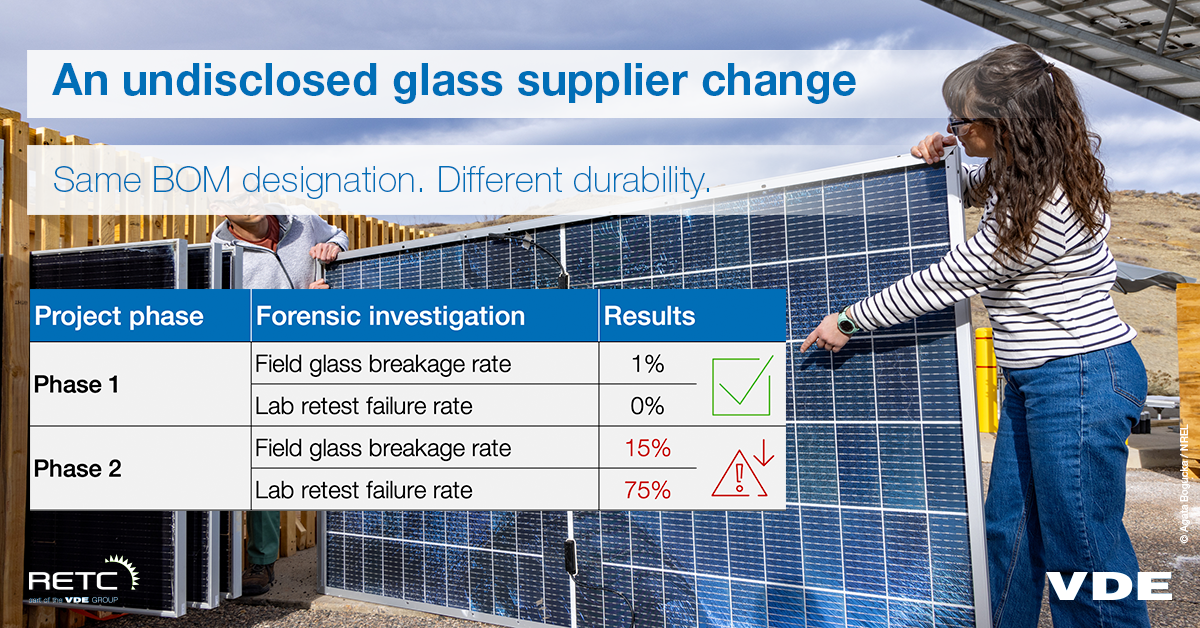
When the developer submitted spare modules from both phases to RETC for evaluation, nearly 75% of samples from the higher-failure phase failed. This was traced to an undisclosed change in glass suppliers. While the manufacturer considered the modules equivalent because they shared the same BOM designation, the substitution resulted in materially different reliability outcomes.
Post-installation investigations can identify the cause of a failure. The greater opportunity, however, lies in detecting material or manufacturing changes before equipment reaches the field. Factory inspections, verification of critical materials and suppliers, and pre-shipment inspections can confirm whether the modules being produced remain consistent with the product originally qualified. If discrepancies are identified, buyers can require additional testing before accepting delivery.
In this case, verifying the glass supplier during production could have prompted additional mechanical stress testing before shipment, potentially avoiding the cost and disruption of widespread breakage after installation.
No inspection or testing program can eliminate every manufacturing or field-performance risk. But the combination of certification, tBOM-specific bankability testing, production oversight, and pre-shipment verification creates a more continuous qualification process. This system gives buyers greater confidence that the modules being delivered still reflect the materials, construction, and performance characteristics that underpinned the original purchasing decision.
That continuing body of evidence shifts qualification from a one-time certification decision to an ongoing process of verifying that the purchased product is consistent with the one originally evaluated.
Extended durability data and vendor qualification
Large developers and asset owners typically maintain approved or pre-qualified vendor lists for module manufacturers. Earning a place on those lists requires more than certificates and spec sheets. Buyers look for independent data to evaluate product durability, bill-of-materials consistency, and long-term performance risk.
Independent engineers often play an important role in that review. When they recognize the testing protocol and consider the resulting data relevant to the project, the qualification process can move forward more efficiently. When the methodology, the tested bill of materials, or the supporting documentation is unclear, the manufacturer may be asked to provide additional information or to complete further testing.
Approved vendor lists are also not static. Buyers may revisit them annually, when a manufacturer introduces a new product line, or when materials and suppliers change. These reviews allow procurement and engineering teams to consider updated evidence rather than treating qualification as a one-time decision.
This increased scrutiny reflects the growing financial consequences of underperformance. As projects grow larger and expected operating lives extend beyond 30 years, even modest differences in reliability can have meaningful implications for energy production, operating costs, and investment returns.
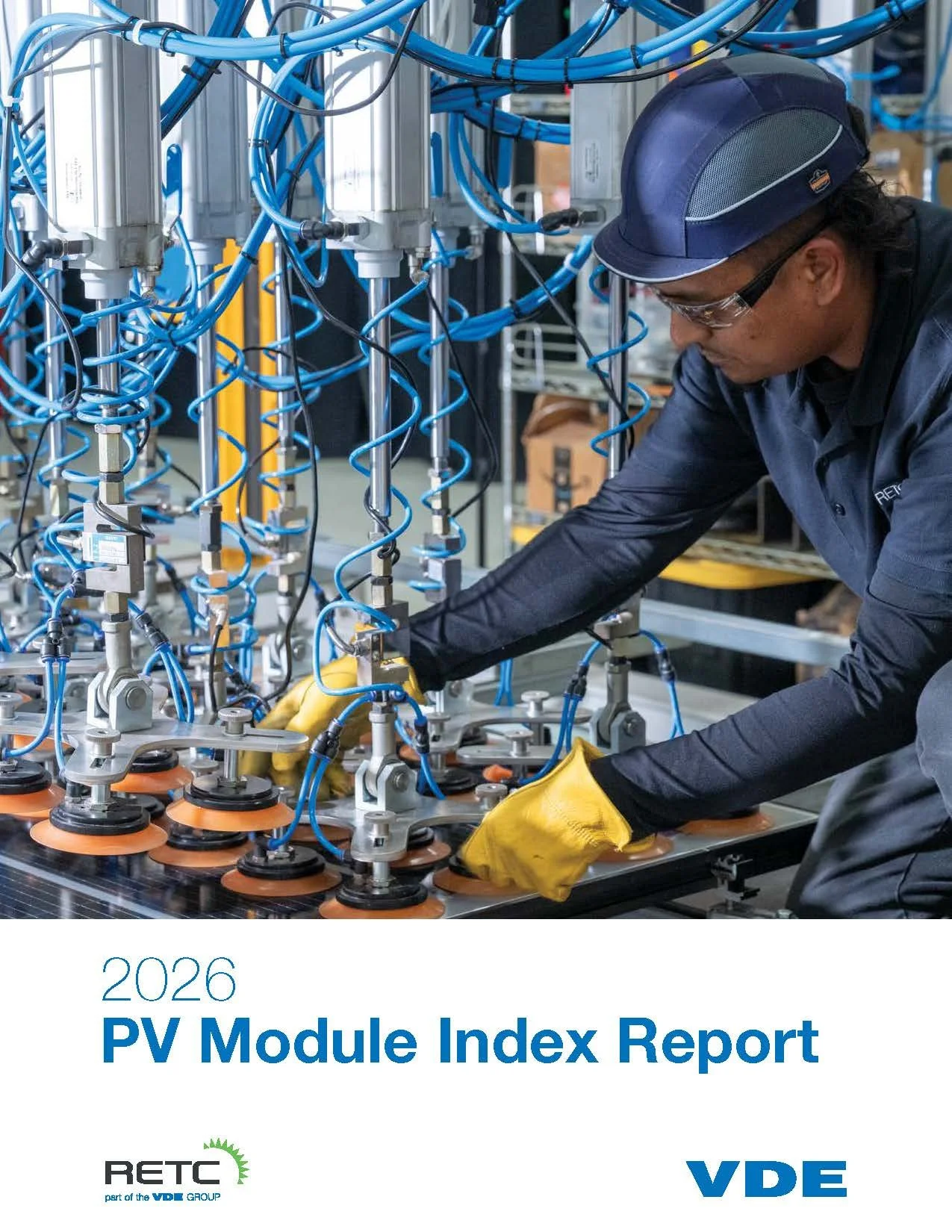
Data cited in RETC’s 2026 PV Module Index Report, drawn from the Department of Energy’s PV Fleet Performance Data Initiative, shows that the median fielded system produced approximately 98.6% of its weather-corrected energy estimate in 2024, compared with roughly 102% in 2020. At the lower end of the distribution, performance declined from approximately 90% of expected output to 85% over the same period.
These figures do not point to a single cause. Some projects may underperform because energy production was overestimated, others because equipment failed to meet expectations, and many because of a combination of both. Regardless of the cause, the trend reinforces the importance of validating both project assumptions and the long-term durability of the equipment expected to deliver them.
Bankability data informs procurement decisions
Extended durability testing does not produce a site-specific product recommendation. Instead, it generates comparative data that procurement and engineering teams can use to evaluate how different products and bills of materials respond to known long-term stressors.
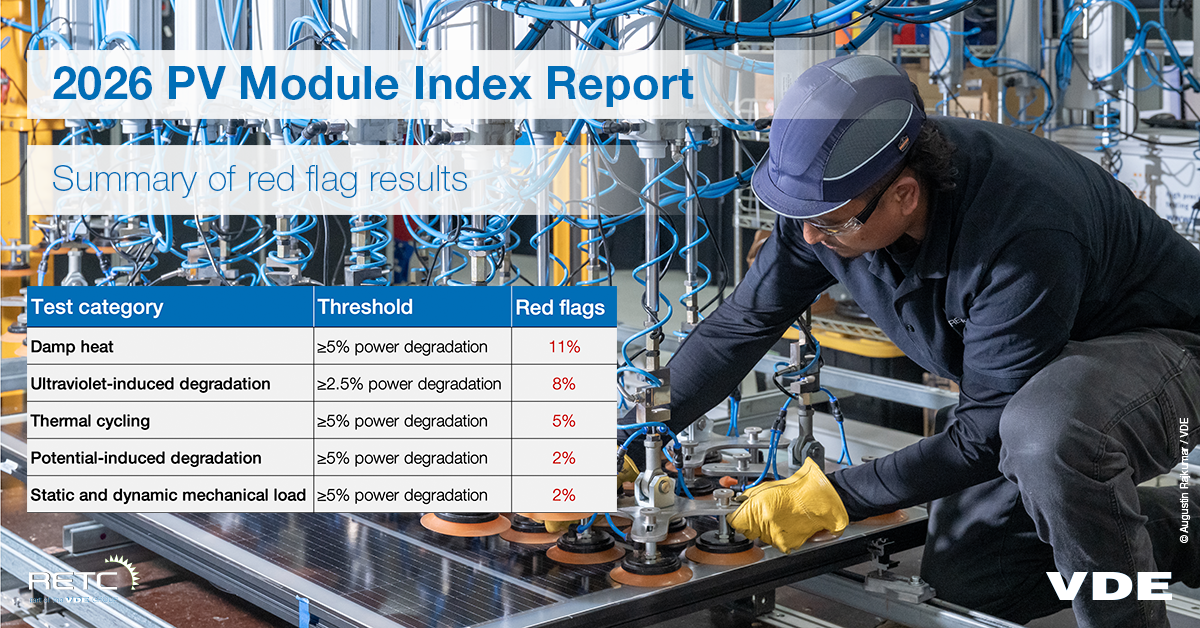
Depending on the testing program, that data may include performance under thermal cycling, damp heat, humidity-freeze exposure, mechanical loading, potential-induced degradation, ultraviolet exposure, and hail impact. The purpose is not to predict every condition a module will encounter in the field, but to identify meaningful differences between products.
That information becomes particularly valuable for buyers managing projects across multiple regions. A module that performs strongly in one test category may be less suited to a project where a different environmental risk is more significant. Procurement teams may prioritize hail resilience in hail-prone regions, extended damp-heat and thermal-cycling performance in hot, humid climates, and mechanical integrity in areas exposed to high winds or heavy structural loads.
A decade ago, manufacturers typically commissioned this testing only when a specific transaction required it. Today, global module oversupply, regulatory uncertainty, and compressed project timelines have shifted expectations. Buyers increasingly expect recognized, independent durability data before procurement discussions begin. For manufacturers, the commercial implication is straightforward. Suppliers that arrive with recognized, BOM-specific evidence can focus discussions on product fit, pricing, and delivery. Those that do not may spend valuable time generating information their competitors already have.
—This article originally appeared in pv magazine USA, a leading source of daily news and analysis regarding the U.S. solar, energy storage, and clean energy markets and policy.
Knowledge is power.
Download the 2026 PVMI today!